Transactions Deep Dive: MVCC, Locks, Isolation, and Two-Phase Commit
How local transactions use MVCC and locks for isolation, how isolation levels change what concurrent Fairfax order queries see, and how two-phase commit coordinates prepare-then-commit across participants—including in-doubt state and PostgreSQL PREPARE TRANSACTION.

Database Pipelines — Part 3/5
Part 2 showed row versions in heap pages and commits riding the WAL. Transactions are the programming model on top: reads and writes that succeed together or not at all, while other sessions run. This part covers ACID, isolation, MVCC, two-phase locking (2PL) ideas, and two-phase commit (2PC) for multi-participant atomicity. Still using customers/orders. Concepts are engine-generic; syntax leans on PostgreSQL.
This is Part 3 of 5 in the Database Pipelines series.
Three different “two-letter” ideas
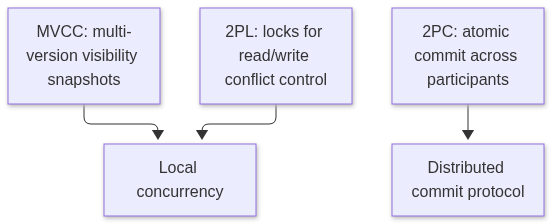
People conflate mechanisms that solve different problems:
| Mechanism | Problem it addresses |
|---|---|
| MVCC | Which row versions a reader may see without blocking every writer |
| 2PL (two-phase locking) | Classical lock acquire/release discipline so concurrent schedules stay serializable-ish |
| 2PC (two-phase commit) | Whether multiple participants all commit or all abort as one global decision |
PostgreSQL leans on MVCC for ordinary reads, still uses locks for writers and some reads (FOR UPDATE), and implements 2PC mainly for external transaction managers via PREPARE TRANSACTION—not as the default app coding style.
ACID in practice
- Atomicity.
BEGIN…COMMITapplies all bounded local writes, orROLLBACKapplies none. - Consistency. Declared constraints still hold after commit.
- Isolation. Concurrent transactions interact only as allowed by the isolation level.
- Durability. After commit, effects survive crashes because WAL said so (Part 2).
BEGIN;

UPDATE orders
SET status = 'paid'
WHERE order_id = 1001
  AND status = 'pending';

INSERT INTO payments (order_id, amount_cents)
VALUES (1001, 4999);

COMMIT;
(Assume a payments table in a real schema.) This is a local transaction—one PostgreSQL database—not 2PC.
Isolation levels
SQL isolation levels trade anomalies for concurrency. Stricter levels forbid more anomalies, often with more conflicts or retries.
| Level | Rough promise |
|---|---|
| Read Uncommitted | May allow dirty reads; many engines effectively upgrade this |
| Read Committed | See committed data; successive selects may see new commits |
| Repeatable Read | Stable view of already-read data (engine-specific details) |
| Serializable | Appear to run one-after-another |
PostgreSQL: default is Read Committed. REPEATABLE READ uses a transaction snapshot. SERIALIZABLE may abort with a serialization failure you must retry. Dirty reads are not offered the way the loosest SQL label suggests—read the transaction isolation chapter rather than assuming MySQL-like behavior.
For the Fairfax report while another session marks orders paid: Read Committed can return different sets on two selects in one transaction; a snapshot isolation mode keeps one view for the transaction.
MVCC: versions and snapshots
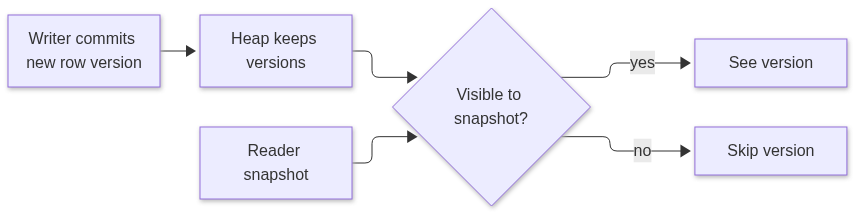
MVCC keeps multiple row versions (Part 2). Each transaction uses a snapshot (statement- or transaction-scoped) to decide visibility.
In PostgreSQL, fields such as xmin / xmax record which transactions created or expired a version. Readers skip invisible versions instead of always waiting on writers—while writers may still block writers, and some modes add extra checks.
Implications: long transactions delay vacuum; “I updated status but the report lags” is often isolation timing; hot rows churn versions.
Locks remain necessary
MVCC does not remove locking. Row locks serialize writers on the same order_id. SELECT … FOR UPDATE pins rows for payment capture. Foreign keys lock parents. Deadlocks abort one side—retry with backoff.
BEGIN;
SELECT * FROM orders WHERE order_id = 1001 FOR UPDATE;
UPDATE orders SET status = 'paid' WHERE order_id = 1001;
COMMIT;
Classical 2PL says: grow the lock set, then shrink—no lock–unlock–lock patterns that break serializability proofs. Real engines mix MVCC with selective locking rather than textbook 2PL alone; the label is still useful when reading concurrency literature.
Two-phase commit (2PC)
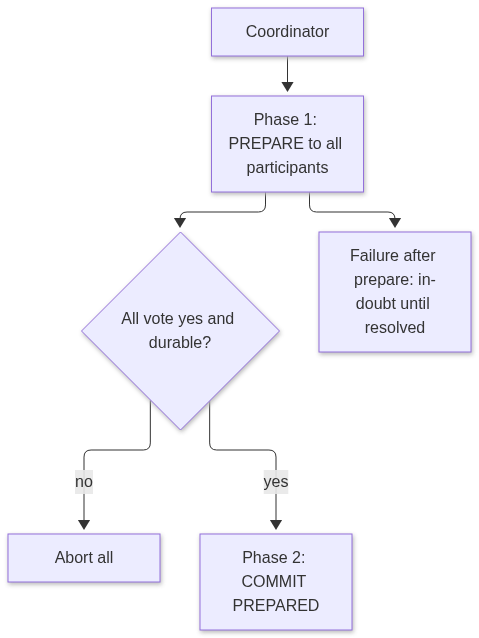
When one business commit must span more than one transactional resource (two databases, database + message queue with XA, etc.), local COMMIT is not enough. 2PC introduces a coordinator and participants:
Phase 1 — Prepare
- Coordinator asks each participant to prepare.
- Each participant does everything that might still fail for commit: flush enough state that it can promise “I can commit or abort on command,” and records a durable prepared vote.
- Participant answers yes (prepared) or no.
If any vote is no (or times out before prepare completes), the coordinator instructs everyone that is not prepared—or that can still abort—to abort.
Phase 2 — Commit or abort
- If all required participants voted yes, the coordinator records its global decision and sends commit (
COMMIT PREPAREDin PostgreSQL). - Otherwise it sends abort (
ROLLBACK PREPARED).
After a participant has entered prepared state, it must not unilaterally forget the transaction: it is in doubt until the coordinator’s decision arrives. It may hold locks and block vacuum (PostgreSQL warns about this explicitly).
Failure, blocking, and operations
- Crash before prepare completes: treat like local abort paths.
- Crash after prepare, before the participant learns the outcome: on restart the participant must ask the coordinator (or a transaction log) what to do. This is the classic blocking downside of basic 2PC: a missing coordinator stalls prepared work.
- Do not assume “coordinator timeout ⇒ safe to abort after prepare.” Once prepared, aborting without the global decision can fork reality (one side committed, one aborted). Timeouts before prepare are different from timeouts after prepare.
- Prepared transactions that linger interfere with cleanup and can contribute toward wraparound risk in PostgreSQL—resolve them quickly.
PostgreSQL: PREPARE TRANSACTION is not normal app default
BEGIN;
-- local statements on this database
PREPARE TRANSACTION 'orders-pay-1001';
-- later, usually from a transaction manager:
COMMIT PREPARED 'orders-pay-1001';
-- or ROLLBACK PREPARED 'orders-pay-1001';
Official docs state this is for external transaction managers, not interactive apps. Default max_prepared_transactions = 0 disables the feature until you opt in. Ordinary services should prefer single-database transactions, outbox patterns, or sagas unless they truly run a TM.
2PC is not a substitute for MVCC, and MVCC is not distributed atomic commit.
Bridging back to the Fairfax query
SELECT c.email, o.order_id, o.total_cents
FROM customers AS c
JOIN orders AS o
  ON o.customer_id = c.customer_id
WHERE c.city = 'Fairfax'
  AND o.status = 'paid'
  AND o.created_at >= TIMESTAMP '2026-01-01';
Under Read Committed, each statement sees newly committed data. Under a transaction snapshot, the join is stable for the txn. Neither replaces correct write transactions—or 2PC when payment authorization lives in another system that must commit atomically with orders.
What to practice
- Keep multi-step local writes in explicit transactions.
- Choose isolation for reader correctness; retry serialization failures.
- Keep transactions short so versions and locks clear.
- Reach for 2PC only with a real coordinator and monitoring for in-doubt txns—not as a default ORM setting.
Limits and next
Distributed sagas and every SQL anomaly name are out of scope. Part 4 turns to caching: buffer pools, OS cache, cache-aside, invalidation, and stampede control—without treating every engine the same.
References
- PostgreSQL Documentation: Transaction Isolation
- PostgreSQL Documentation: Concurrency Control (MVCC)
- PostgreSQL Documentation: Explicit Locking
- PostgreSQL Documentation: PREPARE TRANSACTION — 2PC participant API; not for ordinary apps
- PostgreSQL Documentation: Two-Phase Transactions
- PostgreSQL Documentation: COMMIT PREPARED
About the author
I write about Applied AI, MCP, Azure AI Search, and RAG. Follow me on Dev.to and Hashnode for more.
About the author
- Software engineer writing about AI coding tools, RAG, and Azure AI Search.
Comments
Join the discussionNo comments yet. Be the first to comment.